How Duplicate Content Affects AI Search Visibility?
The evolution of search engines from basic keyword matchers to advanced AI-driven systems has significantly changed how content is discovered, evaluated and ranked. Today, search engines such as Google and Bing rely on the artificial intelligence, machine learning and natural language processing to better and properly understand user intent and content relevance. In this environment, duplicate content has become a critical factor influencing AI search visibility not because it always results in penalties, but because it affects how content is indexed, selected and displayed.
Understanding how duplicate content is interpreted by AI-powered search systems is essential for businesses, publishers and content creators seeking sustainable organic visibility.
Understanding Duplicate Content in the AI Search Context
Duplicate content basically refers to the blocks of content that are identical and similar or substantially similar across different URLs, domains or platforms. This may include copied blog posts, reused service descriptions, syndicated articles without proper attribution or multiple internal pages containing near-identical text.
Importantly, duplicate content is not always created with a manipulative intent. It usually arises from various technical issues, content management practices or legitimate reuse of information. Search engines acknowledge this reality and generally do not penalize any duplicate content unless it is deceptive or intended to manipulate rankings.
In AI-driven search systems, duplicate content is evaluated not only on exact wording but also on semantic similarity. Modern algorithms can understand meaning, structure and topical overlap. As a result, pages that are lightly rewritten but offer no additional value may still be treated as duplicates.
How AI Search Engines Handle Duplicate Content?
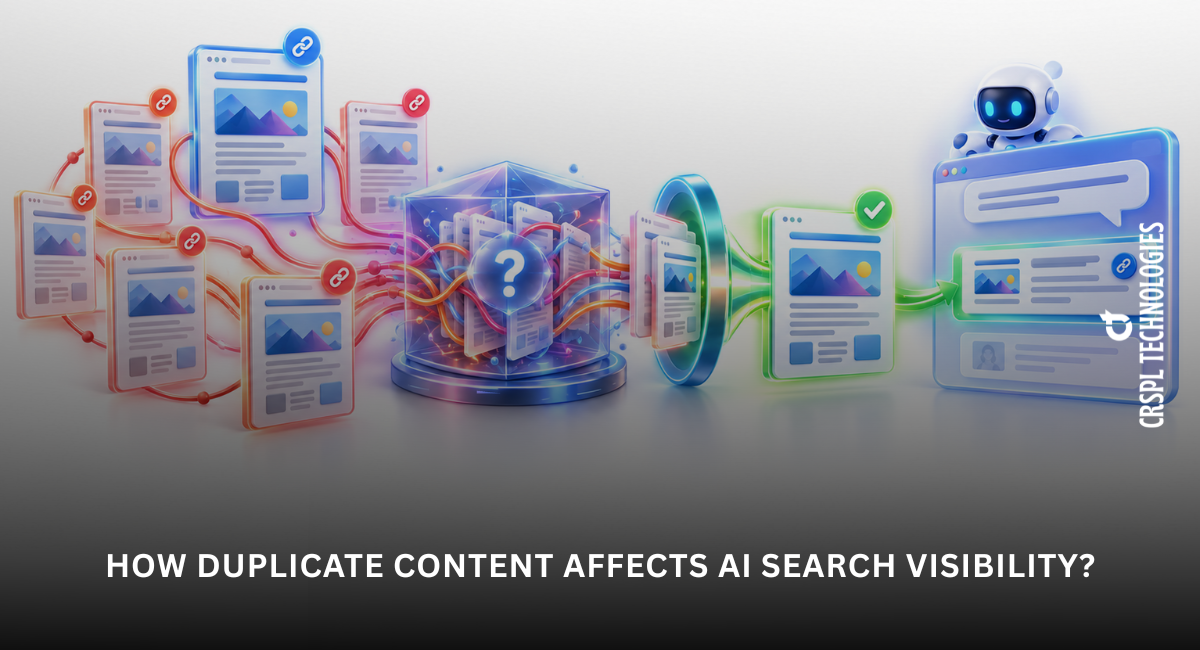
AI search engines aim to provide users with the most relevant, authoritative and useful result for a given query. When multiple versions of substantially similar content exist, search systems must determine which version to prioritize.
Rather than penalizing duplicate content outright, search engines typically: -
- Select one version as the canonical or primary result
- Filter or suppress other similar versions from prominent visibility
- Consolidate ranking signals, such as links and relevance, where possible
This results in duplicate pages competing with one another, which dilutes their overall ranking strength instead of enhancing it.
Impact of Duplicate Content on AI Search Visibility
1. Reduced Crawling and Indexing Efficiency
AI-driven search systems are basically designed to maximize the efficiency. When several similar pages are identified or detected, search engines often limit crawling and indexing to fewer versions to conserve resources. Consequently, duplicate pages may be crawled less often, indexed inconsistently or omitted from search results entirely.
2. Dilution of Ranking and Authority Signals
Search engines use signals such as backlinks, internal links and also user engagement to examine content authority. When identical or similar content exists across various URLs, these signals are divided rather than concentrated. This dilution can prevent any single page from achieving strong visibility.
3. Weaker Content Quality Signals
AI systems are primarily designed to reward originality, genuineness, usefulness and expertise. A website with repetitive or templated content may be assessed as offering limited value, even if the content is technically clear and accurate. Over time, excessive duplication may affect how search engines perceive the overall quality of a site’s content.
4. Negative User Engagement Signals
User experience plays a significant role in AI-assisted ranking systems. Pages that offer no new information are more likely to result in quick exits, lower engagement or reduced satisfaction. These behavioural signals can reinforce the perception that duplicate content is less relevant for users.
5. Lower Eligibility for AI-Generated Search Features
With the rise of AI-powered answer engines and generative search experiences, content is increasingly selected as a source for summaries, answers and recommendations. Search systems prefer content that is unique, clearly structured and authoritative. Duplicate or repetitive content is less likely to be chosen as a trusted reference in these AI-driven results.
Common Causes of Duplicate Content
Duplicate content issues usually arise unintentionally. Common causes include: -
- Multiple URL versions of the same page (HTTP/HTTPS, trailing slashes, parameters)
- Printer-friendly or session-based URLs
- Content syndication without proper canonicalization
- Reusing manufacturer or standard descriptions
- Creating multiple pages targeting similar keywords with nearly identical text
Internal duplication such as using the same service descriptions on multiple pages can negatively impact AI search visibility, as search algorithms determine the content patterns across the entire website rather than individual pages alone.
Best Practices to Manage Duplicate Content for AI Search
To improve the level of visibility in AI-driven search environments, content strategies should focus on clarity, originality and proper technical signals.
Key best practices include: -
- Using canonical tags to indicate the preferred version of a page
- Implementing 301 redirects to consolidate outdated or duplicate URLs
- Creating distinct, value-driven content for each page
- Writing unique meta titles and descriptions
- Meaningfully adapting content when repurposing it for different platforms or audiences
Regular content audits help identify duplication at an early stage and ensure that authority signals are strengthened and unified, rather than being diluted or fragmented across multiple pages.
| Read More: How to Use Google Business Profile to Increase Local Visibility? |
Conclusion
In AI-powered search ecosystems, duplicate content does not automatically result in a penalty, but it does pose as a significant hurdle to visibility. Search engines aim to present a single, high-quality result instead of multiple near-identical versions of the same information. Duplicate content can limit crawling efficiency, dilute authority signals and minimize eligibility for advanced AI-driven search features.
By understanding how AI search systems interpret duplicate content and by implementing best practices focused on originality and proper technical structure, businesses and content creators can help to improve discoverability, trust and long-term organic performance. If you are seeking help in Youtube SE, do contact to CRSPL Technologies, our experts will assist you.