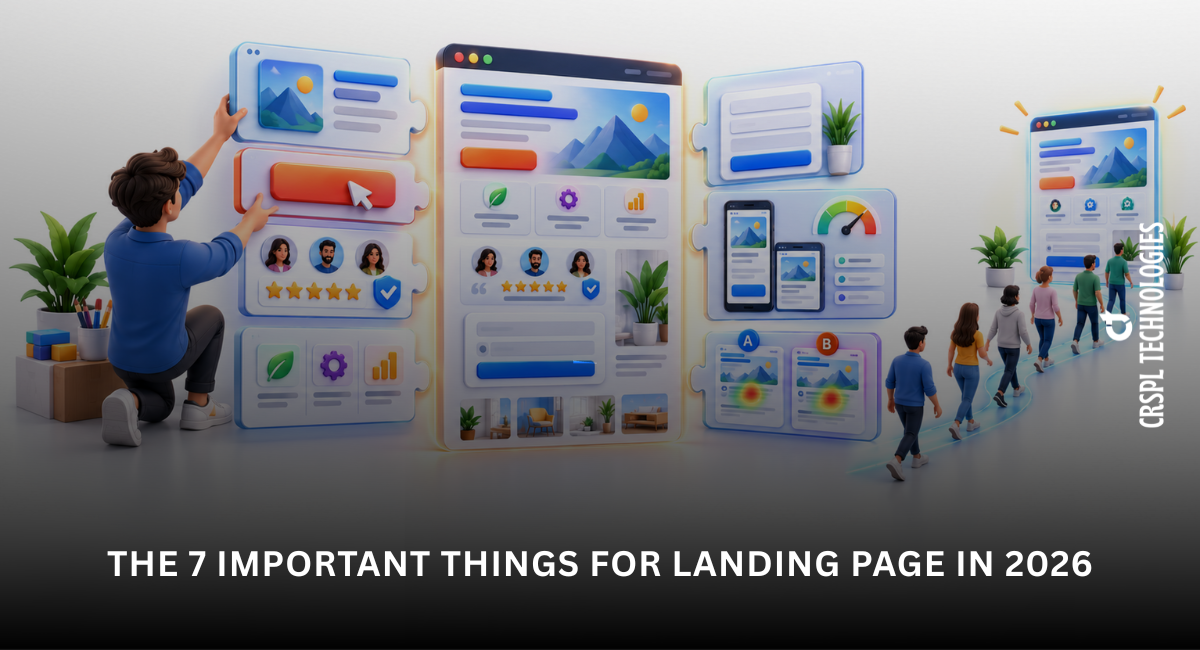
The 7 Important Things for Landing Page in 2026
As digital competition intensifies and user attention spans continue to shrink, landing pages in 2026 must do far more than simply “look good.” They must be fast, intelligent, personalised and conversion-driven. With the evolving technologies such as AI-based optimisation, voice search, mobile-first indexing and stricter data-privacy regulations, businesses must rethink how landing pages are designed and optimised.
Modern landing pages are no longer static pages; they are strategic conversion assets built in alignment with user experience principles, search engine guidelines and global compliance standards. Whether your objective is lead generation, product sales or app downloads, here are the seven most important elements every landing page must have in 2026 to maximise conversions and user trust.
1. Clear, Value-Driven Headline with Instant Relevance
In 2026, users decide whether to stay on a landing page within three seconds or less. The headline must instantly communicate the relevance and value.
A strong landing page headline should: -
- Address the user’s primary problem or intent
- Clearly communicate the benefit rather than features
- Maintain message consistency with ads, emails or search results
Avoid generic claims. Instead of “Best Marketing Solution,” use a benefit-focused statement such as “Increase Qualified Leads by 40% Using AI-Powered Campaigns.” Clear messaging improves the element of engagement, reduces bounce rates and aligns with modern user-experience standards.
2. Hyper-Personalisation Using AI and Behavioural Data
Generic landing pages are no longer effective. In 2026, AI-driven personalisation has become a core expectation.
High-performing landing pages dynamically adapt based on: -
- User location
- Device and screen size
- Traffic source (search, ads, social media, email)
- Past browsing behaviour or preferences
Personalised headlines, visuals, CTAs and various other offers significantly increase relevance and conversions. Even simple location-based or source-based personalisation can produce measurable improvements in user engagement.
3. Lightning-Fast Load Speed and Core Web Performance Optimisation
Page speed is both a ranking factor and a conversion factor. Users in 2026 expect landing pages to load almost instantly, particularly on mobile devices.
Key performance benchmarks include: -
- Load time under two seconds
- Optimised images and compressed media files
- Clean, lightweight code
- Strong Core Web performance metrics
A slow landing page increases bounce rates, lowers ad quality scores and reduces trust. Performance optimisation is no longer optional; it is a fundamental requirement.
4. Mobile-First and Thumb-Friendly Design
With mobile traffic continuing to dominate or control, landing pages must be designed mobile-first and not adapted from desktop layouts.
Essential mobile design principles include: -
- Single-column layouts
- Large, tap-friendly CTA buttons
- Readable font sizes without zooming
- Minimal scrolling and visual clutter
Thumb-friendly navigation and intuitive layouts make it easy for the various users to take action on smaller screens, enhancing usability and boosting conversion rates.
5. Strong, Action-Oriented Call-to-Action (CTA)
A landing page without a clear CTA fails to guide the user. In 2026, CTAs must be specific, benefit-driven and visually prominent.
Effective CTAs: -
- Use action-oriented verbs (Get, Start, Book, Download)
- Clearly state the value (e.g., “Get Free Consultation”)
- Stand out through contrast, spacing and placement
Limiting the page to a single primary CTA minimizes the confusion and improves conversion focus.
6. Trust Signals and Social Proof for Credibility
With increasing online fraud and data concerns, trust plays a critical role in conversion decisions.
High-converting landing pages include: -
- Client or partner logos
- Customer testimonials and reviews
- Case studies or performance metrics
- Security badges and compliance mention
Authentic social proof reassures users, strengthens credibility and aligns with modern trust and authority standards.
7. Privacy-First Design and Transparent Data Usage
As global data-protection laws become stricter, landing pages must prioritise privacy, transparency and consent.
Best practices include: -
- Collecting only essential information and data in any form
- Displaying clear privacy notices near CTAs
- Implementing cookie consent mechanisms
- Clearly explaining that how user data will be used
A privacy-first approach builds long-term trust, confidence and significantly reduces form abandonment, especially for B2B and high-value services.
| Read More: Top 10 Digital Marketing Trends for 2026 |
Conclusion
Landing pages in 2026 are no longer simple marketing pages, they are intelligent, personalised and compliance-ready conversion tools. By focusing on clear messaging, AI-powered personalisation, speed optimisation, mobile usability, trust signals and privacy-first design, businesses can easily stay competitive in an increasingly crowded digital landscape.
When a landing page incorporates these seven essential elements, it doesn’t just attract the traffic, it converts visitors into leads, customers and long-term brand advocates. If you are seeking help in Youtube SE, do contact to CRSPL Technologies, our experts will assist you.