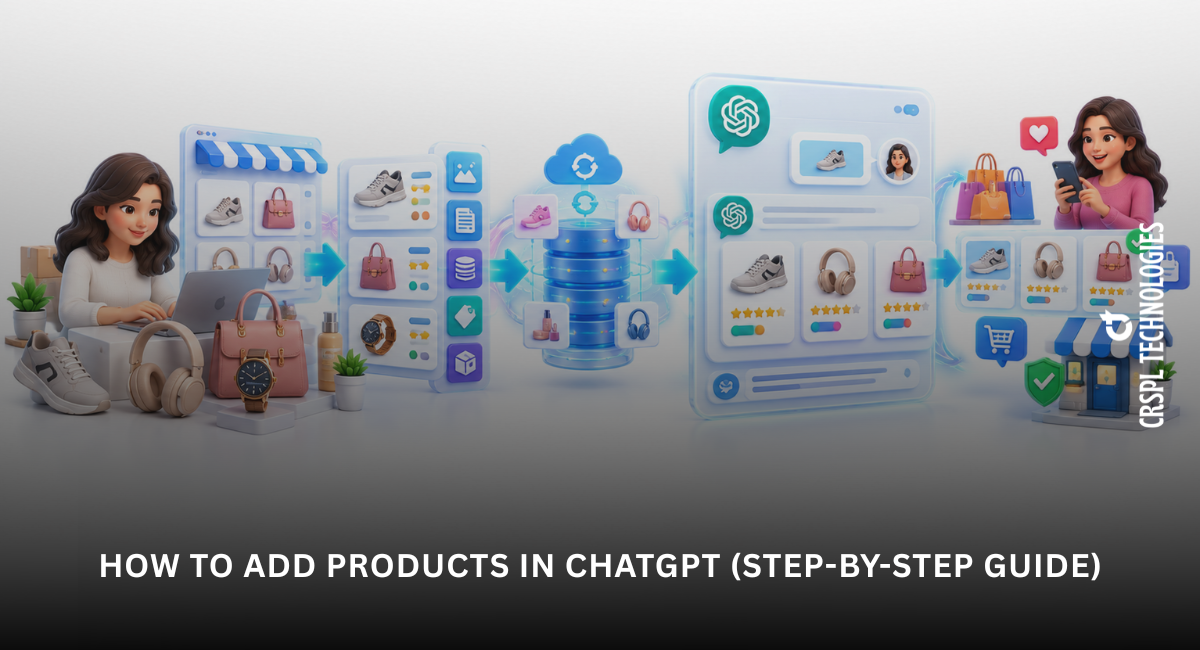
How to Add Products in ChatGPT (Step-by-Step Guide)
The way customers discover and evaluate products online is evolving rapidly. With the rise of AI-powered tools, businesses are increasingly exploring how platforms like ChatGPT can support product discovery, recommendations and customer assistance. For e-commerce brands, SaaS companies and service providers, understanding how to add products to chatgpt in the correct and compliant way can provide a competitive advantage in the AI-driven shopping landscape.
It is important to clarify from the outset that ChatGPT is not a traditional marketplace. You cannot directly upload or list products inside ChatGPT like you would on Amazon or Flipkart. Instead, “adding products in ChatGPT” refers to making product information accessible and discoverable through AI-powered systems, integrations and connected platforms.
This step-by-step guide explains how ChatGPT product discovery works, how businesses can prepare product data for AI visibility and how ChatGPT supports modern eCommerce and digital commerce strategies.
What Does “Adding Products in ChatGPT” Mean?
Adding products in ChatGPT does not involve uploading a catalog into ChatGPT itself. Instead, it refers to enabling ChatGPT-powered tools and integrations to access, understand and present product information when users ask shopping-related or product-related questions.
In practical terms, this means: -
- Making products discoverable through AI-driven conversational search
- Connecting product catalogs via APIs or GPT-based tools
- Allowing ChatGPT to explain, compare or recommend products
- Using ChatGPT to assist with product content creation and customer queries
ChatGPT relies on structured data, connected systems and accessible information, not native product hosting to submit product to chatgpt.
Why Use ChatGPT for eCommerce?
Using ChatGPT in eCommerce and digital commerce workflows can help businesses: -
- Improve product discovery through conversational queries
- Provide AI-powered product explanations and comparisons
- Offer 24/7 customer assistance for product-related questions
- Reduce customer support workload
- Enhance personalization and user experience
As conversational and AI-assisted shopping grow and evolve, businesses that prepare their product data early for chatgpt product listing will be better positioned for future discovery channels.
Step-by-Step Guide: How to Add Products in ChatGPT
Step 1: Prepare Your Product Data
The foundation of the AI-based product discovery is clean, structured and accurate product data. Ensure your product information includes: -
- Product name and category
- Clear descriptions and specifications
- Pricing and availability (kept up to date)
- Images and variations
- Use cases and common customer questions (FAQs)
Well-organized product data makes it easier for AI-powered tools to understand and surface relevant information.
Step 2: Use ChatGPT to Create and Optimize Product Content
Even if your products are hosted on your website or an eCommerce platform, ChatGPT can be used to create and improve product-related content.
ChatGPT can help you: -
- Write SEO-friendly product titles
- Generate clear and detailed product descriptions
- Create feature-benefit bullet points
- Draft product FAQs and usage explanations
This is one of the most practical ways to manage and enhance the product content using ChatGPT.
Step 3: Enable Product Access Through APIs or GPT-Based Integrations
For advanced use cases, businesses can enable AI-based product access through: -
- Custom APIs connected to internal product databases
- GPT-based tools built using OpenAI APIs
- Integrations with the various e-commerce platforms, such as Shopify or WooCommerce
- CRM or inventory management system connections
These integrations allow ChatGPT-powered applications to retrieve relevant product information, such as specifications or availability, during customer interactions. This approach supports scalable, AI-assisted product discovery without directly hosting products in ChatGPT.
Step 4: Support AI-Powered Product Discovery
Once product data is accessible through connected systems, ChatGPT can assist users by: -
- Recommending products based on user intent
- Comparing features between products
- Answering “which product is best for…” type questions
- Suggesting alternatives based on needs or constraints
This is where the AI-powered discovery adds value by helping various users move from research to informed decision-making.
Step 5: Optimize for Conversational and AI-Based Queries
To improve visibility in AI-driven search and conversational interfaces, businesses should focus on: -
- Natural, conversational product descriptions
- Question-based content aligned with the customer intent
- Clear and proper explanations of benefits and use cases
- Well-structured FAQs
This helps to ensure your product information is suitable for AI-generated responses and conversational discovery.
Step 6: Monitor, Update and Improve Product Information
AI systems depend on accurate and current information. Regularly:
- Update pricing, availability and specifications
- Refine descriptions based on customer feedback
- Add new FAQs based on real user queries
- Improve content clarity and structure
Ongoing optimization ensures consistent performance in AI-powered product discovery experiences.
Benefits of Enabling Products for ChatGPT-Powered Discovery
- Improved the visibility through conversational AI interactions
- Faster, easier and more informative responses for customers
- Enhanced trust through clear and consistent product explanations
- Reduced dependency on manual customer support
- Better engagement across digital touchpoints
When implemented correctly, ChatGPT-based product discovery becomes a powerful and effective support tool to help chatgpt discover your products rather than a standalone sales platform.
| Read More: Top Digital Marketing Agency in Delhi: Grow Your Business with Expert Strategies |
Conclusion
To understand how to add products in ChatGPT means understanding how AI-driven discovery works. Rather than uploading the products directly, businesses must focus on structured data, integrations and conversational optimization.
As AI continues to reshape digital commerce, brands that adapt their product information for conversational and AI-based discovery will gain a long-term advantage in visibility, trust and customer engagement.
Call CRSPL Technologies for How to Add Products in ChatGPT
If you want expert guidance on enabling AI-powered product discovery, ChatGPT integrations, and eCommerce automation, CRSPL Technologies can help you design compliant, scalable solutions that align with modern AI capabilities and business goals.