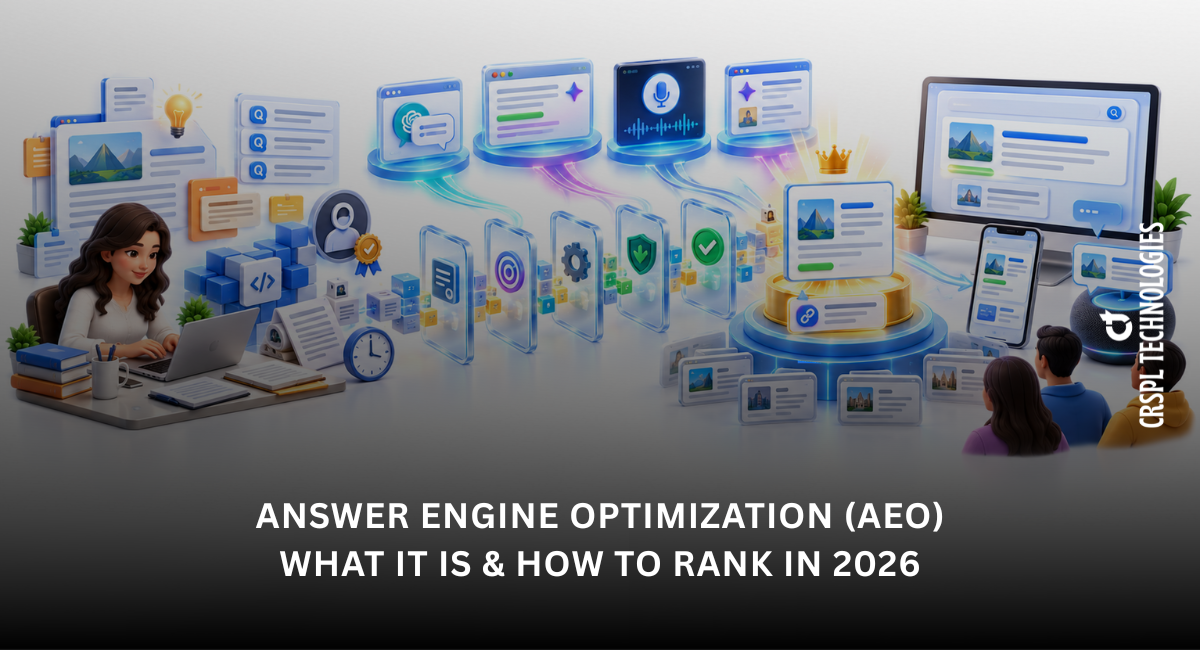
Answer Engine Optimization (AEO): What It Is & How to Rank in 2026
In 2026, digital search is emerging very fast with the integration of artificial intelligence into search engines and user interfaces. While traditional Search Engine Optimization (SEO) continues to play a critical role, the way users discover information is changing. AI-powered search features, conversational interfaces, and voice assistants now prioritize direct, well-structured answers over long lists of links.
This major shift has led to the growing importance of Answer Engine Optimization (AEO), an approach that focuses on making content easily understandable and retrievable by AI-driven search systems.
This blog explains what Answer Engine Optimization is, how it differs from SEO, and how businesses can optimize content to improve visibility in AI-enhanced search experiences in 2026.
What Is Answer Engine Optimization (AEO)?
Answer Engine Optimization (AEO) is the practice of structuring and optimizing content so that search engines and AI systems can clearly identify, extract, and present direct answers to user queries.
Unlike traditional SEO, which primarily focuses on ranking webpages in search results, AEO emphasizes:
- Clear and concise answers
- Question-based content
- Logical structure and context
- Machine-readable formatting
The goal of AEO is not to replace SEO but to complement it by improving the likelihood that content is featured in AI-powered results such as featured snippets, “People Also Ask” boxes, voice search responses and conversational AI outputs.
As search engines increasingly surface answers directly on the results pages, AEO helps ensure your content is eligible to be selected as a trusted response.
AEO vs SEO: Key Differences
Understanding the distinction between the AEO and SEO helps businesses adapt to modern search behavior:
| Aspect | SEO | AEO |
| Primary Goal | Improve rankings on search result pages | Provide clear, extractable answers |
| Focus | Keywords, backlinks, metadata, page authority | Answer clarity, structure, context |
| User Interaction | Click-driven traffic | Direct responses (including zero-click) |
| Optimization Style | On-page and off-page SEO | Conversational search optimization and structured content |
| Success Metrics | Rankings, organic traffic, CTR | Featured snippets, AI answers, visibility |
SEO remains foundational for authority, confidence, and trust, while AEO builds on that foundation to improve how content performs in AI-driven search features.
Why AEO Matters in 2026
Search engines increasingly integrate AI to improve user experience by delivering faster, more relevant answers. As a result: -
- Many queries are resolved directly on the search interface
- Users expect short, accurate and contextual answers
- AI systems favour content that is easy to interpret and summarize
This makes AEO valuable for businesses seeking to:
- Increase visibility across AI-enhanced search features
- Build brand credibility by being referenced as a reliable source
- Improve user experience through clear and helpful content
While search engines do not require a separate “AEO system,” content that is structured and organized for clarity and relevance is more likely to be surfaced in modern search environments.
How to Optimize Content for AI Search and Answers
Here are practical, SEO-aligned steps to optimize content for AEO in 2026: -
- Conduct Answer-Focused Keyword Research
:Instead of focusing only on short keywords, identify questions and conversational queries your audience is searching for. Examples include:
- “What is answer engine optimization?”
- “AEO vs SEO”
- “How to rank in AI search results.”
Use tools like Google’s “People Also Ask,” search suggestions, and customer queries to guide content creation.
- Write in a Clear, Conversational Tone
AI systems favor content that mirrors how users naturally ask questions. Use:
- Simple language
- Short paragraphs
- Direct answers before detailed explanations
Try to avoid unnecessary jargon while maintaining professional clarity.
- Structure Content for Readability and AI Parsing
Well-structured and organised content improves both user experience and AI comprehension: -
- Use proper H1, H2, and H3 headings
- Add bullet points and numbered steps
- Include tables where helpful
- Organise the FAQs clearly
Implementing the structured data (schema markup) can further help search engines to better understand the real context of content.
- Optimize for Featured Snippets and Zero-Click Results
It includes concise answer blocks (typically 40–60 words) immediately after the question-based headings. These formats are well-suited and appropriate for:
- Featured snippets
- Voice search responses
- AI-generated summaries
Zero-click visibility still enhances brand recognition, even when the users don’t visit the website directly.
- Update and Reformat Existing Content
AEO is not only about creating new content. Existing pages can be improved by: -
- Adding FAQ sections
- Rewriting long paragraphs into clear answers
- Updating facts, examples and definitions
- Improving formatting for clarity
This approach enhances both SEO and AI search performance.
- Use Semantic and LSI Keywords. Naturally
Incorporate related terms to help AI to understand the context, such as: -
- Answer engine optimization
- Optimize for AI search
- Conversational search optimization
- AI search optimization
- Zero-click search
These should be used naturally within the content so they add value to the information rather than feel forced.
| Read More: 200+ Viral Instagram Hashtags to Boost Reach in 2026 |
Conclusion
In 2026, Answer Engine Optimization is best understood as an evolution of SEO and not a replacement. As AI continues to shape how users search for and consume particular information, content that delivers clear, accurate, and well-structured answers will perform better across both traditional and AI-powered search environments.
By combining strong SEO fundamentals with answer-focused content strategies, businesses can easily improve their visibility, authority, and long-term search performance.
At Crspl Technologies, we help brands adapt to the modern search trends by creating content strategies and structures that align with both SEO best practices and emerging AI search behavior.