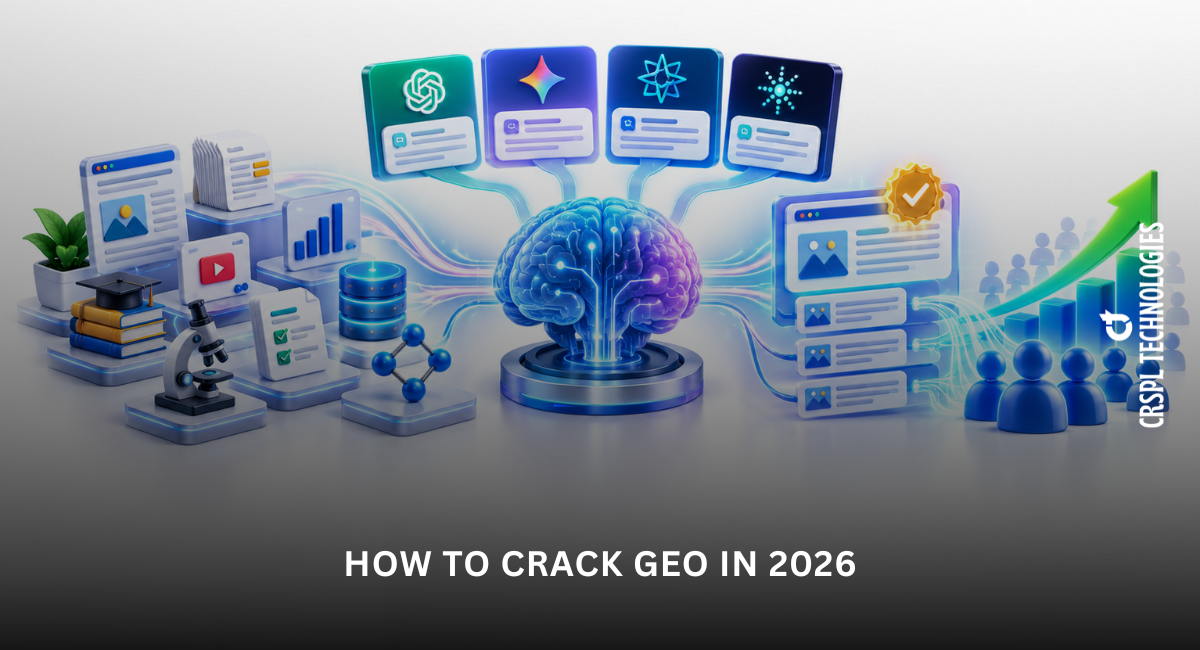
How to Crack GEO in 2026
As search experiences evolve from traditional blue‑link results to AI‑generated answers and summaries, businesses are rethinking how content is created, structured, and evaluated. While Search Engine Optimization (SEO) remains core and foundational, a complementary discipline, commonly referred to as Generative Engine Optimization (GEO) is gaining major attention across the digital marketing industry.
This updated blog aligns with current industry consensus and publicly available guidance from search and AI platforms. It explains what GEO means in practice, how it differs from traditional SEO, and how businesses can easily adapt content strategies and planning responsibly in 2026, without overstating claims or implying any unofficial ranking guarantees.
At CRSPL Technologies, we focus on the future‑ready yet standards‑aligned digital strategies. This blog reflects practical best practices rather than speculative or “official” rules.
What Is Generative Engine Optimization (GEO)?
Generative Engine Optimization (GEO) is an industry term used to describe the practice of creating and structuring content so that AI‑powered systems, such as Google AI Overviews, Bing Copilot, Gemini, and other large language model (LLM)–based interfaces, can:
- Clearly understand the content’s meaning and intent
- Identify trustworthy and authoritative information
- Extract and summarize key points accurately
- Reference or cite the content when generating answers
Unlike traditional SEO, which focuses on ranking web pages in search engine results, GEO focuses on how content is interpreted and reused by generative AI systems. It is not an official Google or Microsoft framework or structure, but it’s an emerging set of best practices based on how AI systems process various types of information and data.
In simple words, basically, GEO helps to ensure that your content is usable by AI, not just indexable by the search engines.
GEO vs SEO: Understanding the Practical Difference
GEO does not replace SEO. Instead, it builds on the SEO fundamentals.
| SEO | GEO |
| Optimizes for rankings and clicks | Optimizes for AI‑generated answers and summaries |
| Focus on crawlers and indexing | Focus on LLM comprehension and context |
| Keywords and backlinks are central | Clarity, structure, entities, and authority are central |
| Page‑level performance | Topic‑ and entity‑level understanding |
SEO drives discoverability. GEO supports AI visibility. In 2026, sustainable digital growth requires both.
Why GEO Matters in 2026
The AI-powered search experiences can now easily deliver direct answers right on the results page, usually providing users with all the information they require without requiring a website visit.
If content is not structured in a way AI systems can confidently understand and summarize, it may be excluded from these responses, even if it ranks well organically.
Industry observations suggest AI systems tend to favor content that demonstrates: -
- Clear topical relevance
- Logical structure and scannability
- Consistent terminology and definitions
- Contextual depth rather than keyword repetition
- Factual accuracy, clarity and credibility
GEO meets these requirements while staying fully aligned with the established SEO practices and norms, industry norms, and core content quality norms and standards.
Practical GEO Strategies for 2026 (Best‑Practice Based)
- Write to Answer Real Questions: AI systems prioritize content that directly addresses the user intent.
Best practices:
- Use descriptive H2 and H3 headings
- Provide a concise answer within the first few lines of each section
- Avoid overly promotional or vague introductions
This approach improves usability for both AI systems and human readers.
- Build Topical Depth, Not Just Individual Pages: LLMs tend to favor sources that demonstrate consistent expertise across a subject area.
Recommended approach:
- Create topic clusters around core services or subjects
- Interlink related articles naturally
- Use consistent definitions and terminology
For example, content about GEO may be supported by articles on AI search behavior, SEO fundamentals, content quality, and structured data.
- Optimize for Entities and Context: Modern AI systems rely heavily on entity recognition: people, brands, concepts, locations, and their relationships.
To support this:
- Clearly define key terms when first introduced
- Mention brand names (such as CRSPL Technologies) naturally and contextually
- Use structured data (schema markup) where relevant and appropriate
This helps AI systems to place your content within a reliable knowledge context.
- Improve Content Structure and Readability: Well-structured and organized content is easier for AI systems to parse and summarize.
Recommended formatting:
- Short paragraphs (2–4 lines)
- Bullet points and numbered lists were relevant
- Clear section transitions and summaries
These practices are already aligned with the modern on‑page SEO and content usability standards.
- Demonstrate Experience, Expertise, and Trustworthiness: Although “E‑E‑A‑T” is not a formal ranking system, quality and credibility signals remain critical.
Strengthen trust by:
- Keeping content accurate and up-to-date
- Avoiding exaggerated or unverified claims
- Supporting statements with logical explanations or data where possible
At CRSPL Technologies, we emphasize content that reflects real expertise and responsible marketing practices and standards.
- Align with Natural, Conversational Queries: AI‑driven search interfaces often mirror how users speak or ask questions.
Instead of focusing only on the short keyword phrases, consider:
- Question‑based headings
- Conversational phrasing
- Clear and proper explanations rather than the keyword density
This improves the alignment with how AI systems interpret intent.
GEO and LLM‑Based Search: What It Really Means
When marketers refer to the “GEO in LLMs,” they are describing the content practices that help large language models:
- Understand intent without ambiguity.
- Identify authoritative explanations.
- Extract accurate summaries.
- Avoid misinterpretation or hallucination.
Content that is thin, unclear, or overly optimized for keywords alone is less likely to be reused in AI‑generated responses.
Important Clarification: GEO Is an Emerging Practice
It is important to note: -
- GEO is not an officially defined or standardized framework published by Google, Microsoft or OpenAI
- There are no publicly confirmed GEO ranking factors
- GEO best practices are based on industry observation, experimentation and alignment with known content quality guidelines
Any responsible GEO strategy should therefore avoid guarantees and remain adaptable as AI search systems evolve.
| Read More: How to Crack AEO in 2026 |
Conclusion
GEO complements SEO; it does not replace it. In 2026, SEO continues to drive the visibility and traffic, while GEO improves the AI understanding and content inclusion. Businesses that prioritize or focus on elements such as clarity, authority, structured content, and user intent, while staying aligned with established SEO principles, will be best positioned to achieve sustainable, long-term digital success.
At CRSPL Technologies, we help brands to navigate evolving search experiences with the balanced, standards-aligned digital strategies and planning that prioritize long-term sustainability over short-term hype.