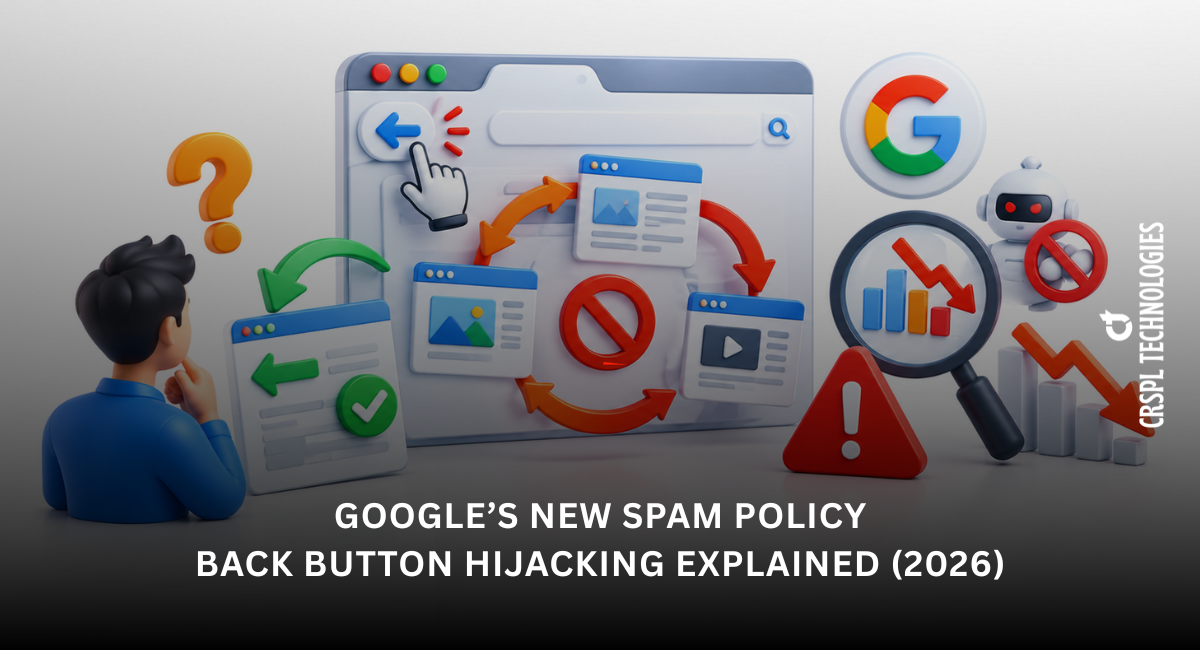
Google’s New Spam Policy: Back Button Hijacking Explained (2026)
In 2026, Google introduced an important and critical update to its search spam policies to target a deceptive or dishonest practice known as back-button hijacking. While it may sound a bit technical, the issue directly affects how users navigate the websites and how websites are ranked in search results.
This update reinforces a clear message: user experience is no longer optional; it’s a core ranking factor.
For the website owners, marketers and developers, understanding this policy is essential to avoid the penalties and maintain search visibility.
What Is Back Button Hijacking?
Back button hijacking occurs when a website interferes with the normal behaviour of a browser’s “back” button.
Typically, when a user clicks the back button, they expect to return to the previous page, often the search results. However, in hijacking scenarios, users may: -
- Be redirected to another page on the same website
- Encounter intrusive pop-ups or ads
- Get stuck in a loop that prevents them from leaving the site
This usually happens when websites manipulate the browser’s history using scripts such as history.pushState() or similar techniques.
Why Google Is Cracking Down on This Practice
According to guidelines from Google Search Central, any attempt to deceptively manipulate user behaviour or navigation is considered a violation of spam policies.
As per Google’s Search Spam Policies, manipulating browser functionality to mislead users is considered a violation.
Back button hijacking falls into this category because it: -
- Disrupts expected user behaviour
- Creates frustration and distrust
- Forces users to stay on a site against their intent
Rather than genuinely improving the engagement, it artificially inflates metrics like session duration and page views, something Google is actively working to eliminate.
How This Impacts SEO
This update is part of a broader shift in SEO where the user experience (UX) plays a central role in the rankings.
Websites that engage in manipulative practices like back button hijacking may face: -
- Ranking drops in search results
- Manual actions from Google reviewers
- Reduced organic traffic
- Long-term damage to the credibility and trust
In simple terms, strategies that try to “trap” users are now treated as spam.
Common Causes of Back Button Hijacking
Not all cases are intentional. Many websites unknowingly trigger this issue due to third-party integrations or the poor implementation.
Common causes include: -
- Aggressive ad networks
- Exit-intent pop-up tools
- Affiliate tracking scripts
- Poorly configured JavaScript libraries
At CRSPL Technologies, we’ve observed that many business websites face this issue due to unverified plugins or ad scripts, especially in affiliate-heavy or ad-driven models.
How to Check If Your Website Is Affected
You can quickly test your website with a simple manual check: -
- Visit your website through search results
- Navigate across a few pages
- Click the browser back button
If you’re unable to return to the previous page or search results smoothly, there may be a problem.
For a more thorough audit: -
- Test on both mobile and desktop
- Use incognito mode
- Try different browsers
This helps identify hidden scripts affecting navigation.
How to Fix Back Button Hijacking
The good news is that this issue is usually fixable with the proper technical checks.
- Audit Your Website Code: Look for unnecessary or suspicious use of: -
- history.pushState()
- history.replaceState()
Remove or correct any misuse.
- Review Third-Party Tools: Carefully analyze: -
- Ad networks
- Plugins and extensions
- External scripts
If a tool interferes with the navigation, it’s best to replace or disable it.
- Focus on Ethical UX Practices: Instead of forcing engagement, prioritize: -
- Clear navigation
- Fast-loading pages
- Non-intrusive design
- Monitor Search Performance: Use the tools like Google Search Console to track: -
- Traffic drops
- Manual action notifications
If penalized, fix the issue and submit a reconsideration request.
The Bigger Picture: Google’s UX-First Approach
This update reflects a larger shift in how Google evaluates websites.
Modern SEO is no longer just about: -
- Keywords
- Backlinks
- Technical optimization
It now heavily depends on: -
- User trust
- Transparency
- Seamless browsing experience
Websites that prioritize the genuine value over manipulation are far more likely to succeed in the long run.
Conclusion
The 2026 update on back button hijacking is a strong reminder that deceptive practices have no place in modern SEO.
Even if implemented unintentionally, such tactics can harm your rankings, traffic and brand reputation.
At CRSPL Technologies, we recommend conducting regular technical audits and focusing on user-first design to stay compliant with evolving search guidelines.
Ultimately, sustainable SEO success comes down to one principle: -
Respect the user’s intent and make their journey as smooth as possible.